
As we move through 2026, Valve has moved far beyond the days of simple file-signature checks, evolving its defense into a sophisticated, multi-layered ecosystem designed to protect the integrity of every Premier match and Major qualifier. From the real-time match cancellations of VAC Live to the deep-learning prowess of VACNet 3.0, the current anti-cheat landscape is defined by a "silent war" between server-side AI and increasingly complex exploits. Whether you're a casual player curious about why a match suddenly ended or a competitive veteran tracking the latest ban waves, understanding the 2026 architecture of Valve’s security is essential to knowing how the game is being kept fair. 

Does CS2 Have Anti-Cheat?

Yes, CS2 has anti-cheat. At its core is VAC (Valve Anti-Cheat), which has evolved from a simple file scanner into a dynamic security suite. Valve uses an updated Trust Factor system to group players based on account history and statistical patterns, and a revitalized Overwatch program that relies on community review. While no system is impenetrable, the 2026 architecture represents Valve's shift toward a server-side, AI-driven defense designed to combat modern exploits.

What Anti-Cheat Does CS2 Use?

Counter-Strike 2 doesn't just use one program to stop cheaters. It uses a team of different tools called the VAC Ecosystem. Unlike some other games that need deep access to your computer files, Valve’s system mostly works "in the cloud" to watch how people play. 

1. VAC Live (The Match Stopper)

This is the most famous part of the system. If it detects a blatant cheater during a live game, it will cancel the match immediately. You’ll see a notification on your screen, the match ends, and nobody loses any Skill Rating (Elo).

2. VACNet 3.0 (The AI Brain)

This is an advanced AI that "watches" every match. It doesn't look for cheat software on your PC; instead, it looks at how you move and aim. If a player’s aim is too fast or precise for a human, the AI flags them for a ban. In 2026, this system has become very good at catching "closet cheaters" who try to hide their hacks.

3. Trust Factor (The Reputation Score)

Think of this as a hidden "goodness" score. Valve looks at your account age, how often you’re reported, and if you play other games fairly.

  • High Trust: You play with other long-term, fair players.

  • Low Trust: You are placed in matches with other suspicious or toxic accounts.

4. Overwatch (Community Review)

Valve also uses a group of trusted players to watch "demos" (replays) of reported matches. If these experienced players agree that someone is clearly cheating, that player gets banned. This mode was in CS:GO, but since the CS2 release, Valve has removed Overwatch from the game.

How Does CS2 Anti-Cheat Work?

In 2026, the Counter-Strike 2 anti-cheat operates as a multi-layered ecosystem that prioritizes real-time behavior analysis over simple file scanning. Here is how the different layers work together:

  • VAC Live (Real-Time Intervention): This is the system's "immediate executioner." It monitors matches in real-time and, if a blatant cheater is detected, it cancels the match instantly. This ensures that legitimate players do not lose Skill Rating (Elo) due to a compromised game.

  • VACNet 3.0 (AI Behavioral Analysis): Rather than just looking for cheat software on your hard drive, this deep-learning AI analyzes "how" a player plays. It identifies non-human patterns—such as pixel-perfect aim adjustments, impossible reaction times, or suspicious movement—to flag accounts even if their cheat software is currently "undetected" by traditional scans.

  • Trust Factor 2.0 (Matchmaking Segregation): Significantly updated in early 2026, this system uses a hidden "reputation" score to group players. It analyzes statistical gameplay anomalies, match history, and report frequency to ensure that honest, long-term players are matched together, while suspicious accounts are isolated into their own queue.

  • Overwatch (Human Verification): To support the AI, Valve utilizes a network of trusted community members and partners to review flagged replays. This adds a human layer of judgment to catch "closet cheaters" who might try to hide their exploits from automated detection.

  • Server-Side Security: Unlike "kernel-level" anti-cheats used in other titles, Valve’s 2026 architecture remains largely server-side. This keeps the system non-intrusive for your privacy while focusing on the data your computer sends to the server.

Does CS2 Use Kernel-Level Anti-Cheat?

No, CS2 doesn’t use Kernel-Level Anti-Cheat. The main difference lies in the level of "privilege" the anti-cheat has within your operating system, often referred to in terms of protection rings:

  • VAC (User-Mode / Ring 3): Valve’s system operates in "Ring 3," the same level as most standard applications (like your web browser or Spotify). It scans for known cheat signatures and monitors game files but cannot see what is happening deep within your Windows kernel. It relies heavily on server-side AI to analyze your movements and aiming patterns to spot anomalies.

  • Kernel-Level (Ring 0): These anti-cheats run at the highest privilege level ("Ring 0"), giving the software full visibility into everything on your computer, including hardware drivers. This allows it to detect sophisticated cheats that load before the game even starts, but it also carries higher risks regarding system stability and personal privacy.

CS2 Anti-Cheat Updates

Since the launch of Counter-Strike 2, the anti-cheat landscape has shifted from a reactive, file-scanning approach to a proactive, AI-driven ecosystem. 

Major Changes Since Release:

  • Real-Time Cancellations: The transition from "delayed ban waves" to VAC Live mid-match interventions.

  • Behavioral AI: The rollout of VACNet 3.0, which focuses on how a player moves and aims rather than just detecting external programs.

  • Overwatch 2.0: The return of community-style review, now streamlined through verified partners to ensure higher accuracy and fewer false positives.

  • Anti-Exploit Updates: Technical overhauls, like the AnimGraph 2 update in April 2026, which refactored player animations to make unnatural, cheat-assisted movements easier for the AI to identify.

Why Do Players Think CS2 Anti-Cheat Is Bad?

Despite the 2026 updates, a significant portion of the community remains frustrated with Valve's anti-cheat, primarily due to the persistence of blatant cheaters in high-rank Premier matches. While the March 2026 ban wave removed nearly one million accounts, players were quick to point out that these were largely farming bots rather than the "spinbotters" and "closet cheaters" ruining competitive games. The perceived failure of VAC Live to cancel matches with obvious hackers, while simultaneously flagging high-skill legitimate players for "irregular gameplay" has led to a crisis of confidence. 

Furthermore, because Valve avoids a kernel-level approach for privacy reasons, many players feel the system is inherently "weaker" than competitors like Vanguard or FACEIT. This sentiment is compounded by the lack of transparency in how the AI learns, leaving many veterans feeling that the "silent war" against cheaters is one that Valve is currently losing on the front lines of matchmaking.

Common Community Grievances:


  • The "False Positive" Problem: Skilled players (especially those from FACEIT Level 10) frequently report being kicked or receiving temporary cooldowns for "suspicious" aim, while actual hackers remain unpunished.

  • Rage Hackers in High Elo: In ranks above 20,000, players still report encountering "spinbots" and blatant wallhackers who can play for weeks without a ban.

  • Delayed Response: Even with VACNet 3.0, many bans are still issued in "waves" rather than instantly, allowing cheaters to ruin hundreds of matches before being removed.

  • Farming Bots vs. Cheaters: There is a common perception that Valve prioritizes cleaning up the "skin economy" (banning bots) over cleaning up the actual gameplay experience.


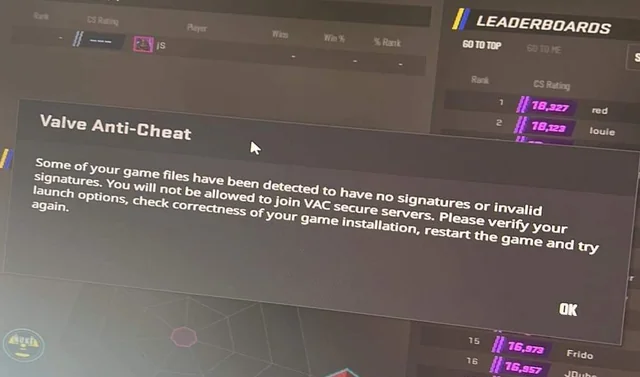
While VAC is designed to catch cheaters, technical hurdles often prevent legitimate players from joining matches. In 2026, most issues fall into these three categories:

1. "VAC was unable to verify your game session"

This is the most frequent error and usually stems from a "handshake" failure between your local files and Valve’s servers. It is rarely a ban; instead, it typically points to:

  • Corrupted game files or outdated Steam service components.

  • Software conflicts with VPNs, aggressive antivirus programs, or third-party overlays.

2. "VAC Authentication Error"

This error is usually triggered by system-level security settings. Common culprits include:

  • DEP (Data Execution Prevention) being disabled in Windows.

  • Permission issues, where Steam requires administrator privileges to verify the game’s environment.

3. "Irregular Gameplay" Flags

A specific 2026 development, these are temporary cooldowns issued by VACNet 3.0. They occur when the AI detects movement or aiming patterns that appear non-human, even if no traditional cheat software is found on the PC.

Quick Troubleshooting Checklist:

  • Verify Integrity: Right-click CS2 in Steam > Properties > Installed Files > Verify integrity of game files.

  • Run as Admin: Fully close Steam and relaunch it by right-clicking the shortcut and selecting "Run as administrator."

  • Repair Steam Service: Open the "Run" dialog (Win+R) and type “C:\Program Files (x86)\Steam\bin\SteamService.exe” /repair.

  • Check Background Apps: Temporarily disable software like CCleaner, PowerShell, or specialized macro tools that might trigger a verification failure.

Will CS2 Get Better Anti-Cheat?

Valve is doubling down on its server-side AI strategy rather than adopting the intrusive, kernel-level approach seen in titles like Valorant. The recent Animgraph 2 update in April 2026 and the ongoing overhaul of the Game Coordinator and game client suggest that Valve is building a more transparent and "cleaner" foundation that makes it easier for VACNet 3.0 to spot anomalies. 


While massive ban waves, such as the removal of nearly one million accounts in March 2026, show the system's scale, the community still pushes for more effective detection of "closet cheaters" in high-Elo Premier matches. The future of CS2 security appears to be a long-term "war of attrition" where Valve uses deep learning to stay one step ahead of cheat developers without compromising player privacy or Steam Deck compatibility.

0 评论

写评论

我们的其他精彩文章