
How Many Maps Does Deadlock Have?
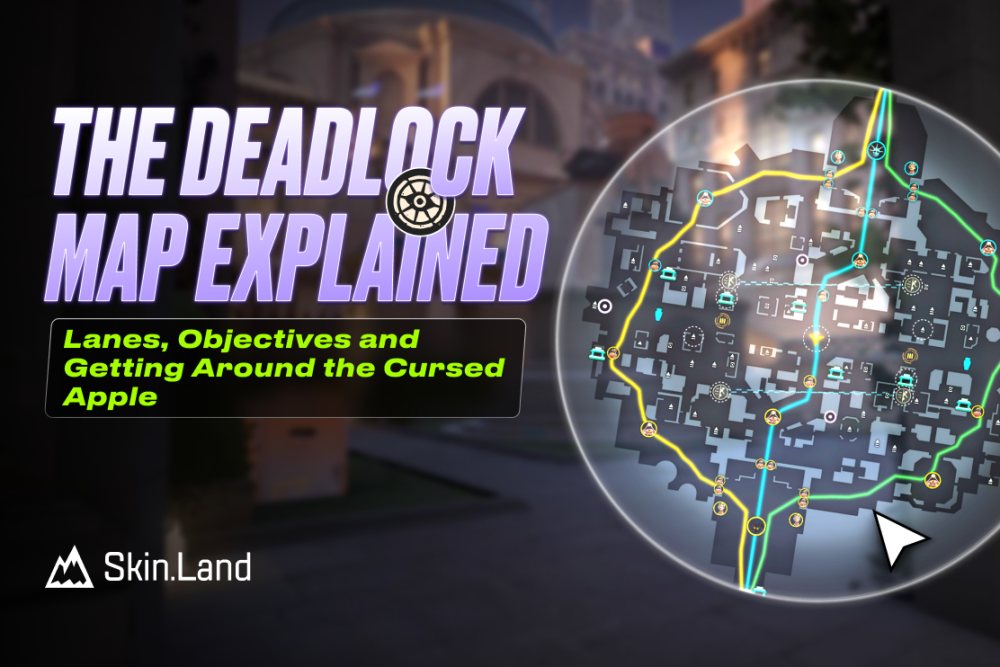
One. Every matchmaking game of Deadlock is played on the same map, and there is no map rotation, no map pool and no map select screen. That is not a gap waiting to be filled. It is the same approach Valve takes in Dota 2, where one map has carried the game for over a decade. The variety is supposed to come from the items and from hero roles, not from the terrain.
Valve has never announced a second map, and nothing in its patch notes points to one. What it does do is rebuild the map it has: there have been two major overhauls so far, and smaller changes land almost every month.
What Changed: The Three-Lane Rework and City Never Sleeps
If you played early and bounced off, the map you remember is gone twice over.
The Map Rework Update, 25 February 2025, is the big one. Valve redesigned the map around three lanes rather than four, and in its own words that dragged in "a large range of accompanying map-wide changes regarding visuals, building layouts, pathways, neutral camps, air vents, breakables, powerup buffs, juke spots, mid boss". Trooper bounty after the laning phase was pushed up to match what the old four-lane economy used to pay out, so the souls maths stayed roughly intact even though a quarter of the map had gone.
That is why "deadlock 4 lane map" is still a live search. It was real, and it is not coming back.
City Never Sleeps, 29 September 2026, was the cosmetic pass — "a massive visual update to the map and neutrals", as Valve put it, landing alongside six new heroes and a HUD overhaul. The layout largely stayed; the city around it was redrawn.
Worth knowing before you read anyone's "complete" map guide: in that same announcement Valve said Midboss, Guardians and Walkers have not been reworked yet, calling them "important but just haven't gotten to yet" and earmarking them for upcoming updates. The map is not finished, and neither is the game, which still has no release date. The parts most likely to move next are the ones you fight over.
The Lanes and the Layout
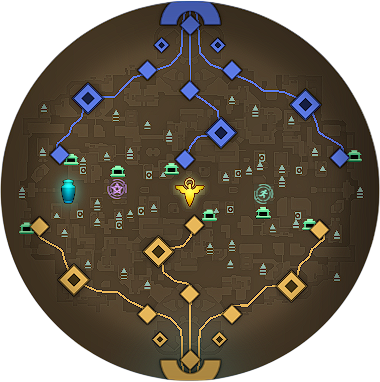
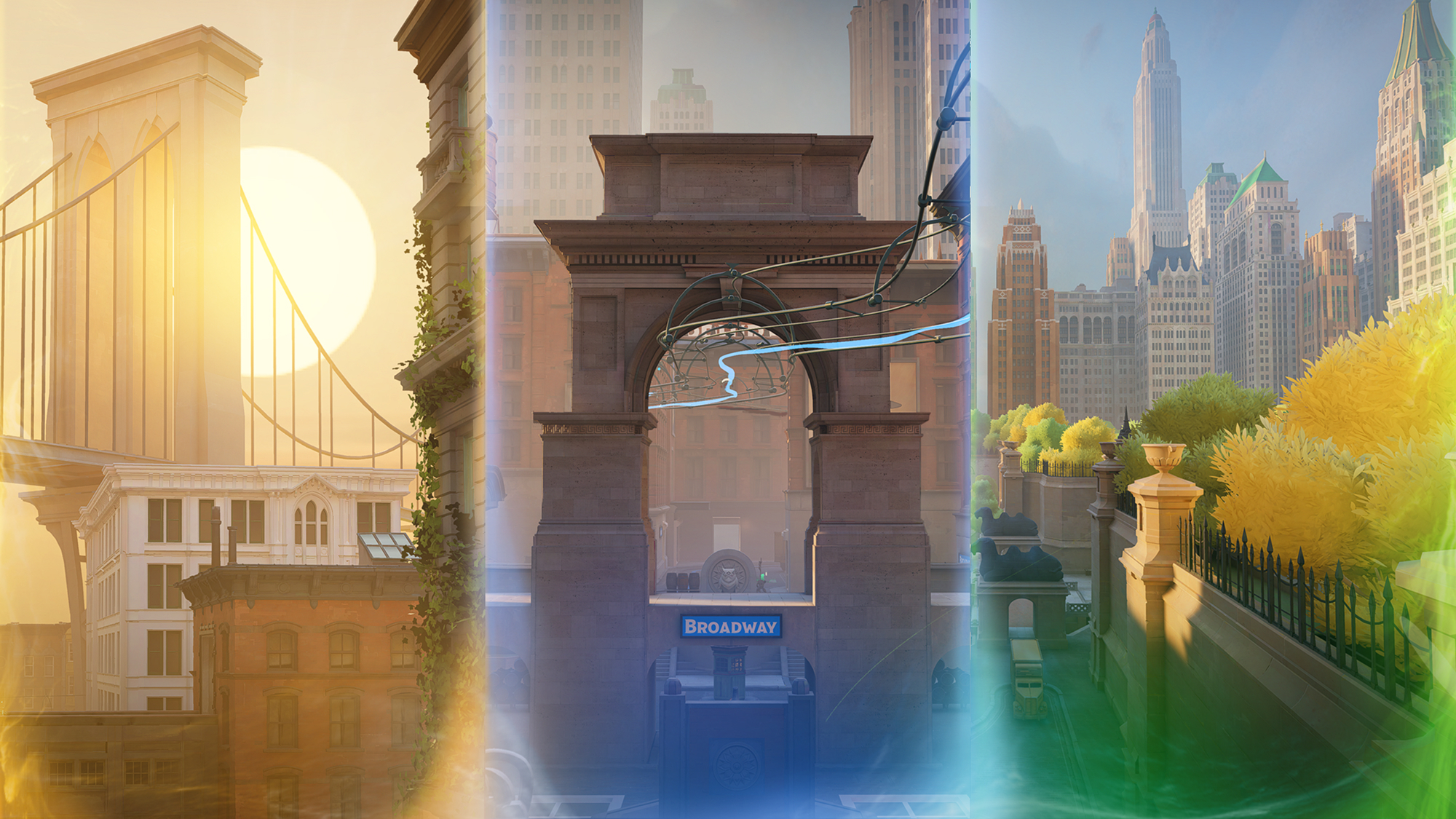
Three lanes run the width of the city, and the two outer ones are themed as distinct districts. Valve's patch notes name the outer Walker arenas Amber Park and Sapphire York. Lanes also carry color shorthand in callouts, which is why you will hear people say "green" or "Park" and mean the same thing; Valve explicitly swapped the green lane's alternative callout from "Greenwich" to "Park" during the rework.
The thing that does not come across in a top-down minimap screenshot is that the Cursed Apple is built vertically. Between the lanes sit rooftops, fire escapes, skybridges, pedestrian bridges and an under-construction suspension bridge on the yellow lane. Fights that start at street level routinely end three storeys up, and a lane is less a corridor than a column of space.
Neutral camps are not tucked out of the way behind the lanes either. Valve moved eight of them — four per side — from outside the outer lanes to the ground between the inner and outer lanes, which is why farming them is a contested act rather than a safe one.
Map Objectives, in Order
The map gives you a fixed sequence of things to break, and they gate your own power as much as the enemy's.
Guardians stand at the front of each lane. They are the first thing you push through, and they are not only an obstacle — your first flex item slot unlocks once two Guardians are down anywhere on the map.
Walkers sit behind them, striding around their arena and stomping anything underneath. Killing one Walker opens your second flex slot. They also project an area buff that shows up in the HUD's active stats.
Shrines come next, guarding the final approach. Two Walkers down opens your third flex slot, and the last one unlocks on the base Guardians.
The Patron is the win condition, sitting in the base behind everything else. Valve overhauled the Patrons and bases in the Old Gods, New Blood update of January 2026.
Alongside that ladder sit three optional objectives that most losses can be traced back to ignoring.
Mid-Boss occupies a pit in the middle of the map and drops the Rejuvenator, which is as close as Deadlock gets to a comeback button. Valve changed how it is collected in the Halloween 2026 update: the Rejuvenator now drops as three crystals spread at random positions around the pit instead of one in the center, each breaking to a single heavy melee, with the total per Mid-Boss kill unchanged at three. The same patch made the Mid-Boss area "a little bigger" with more cover, precisely because fighting in a flat pit was miserable.
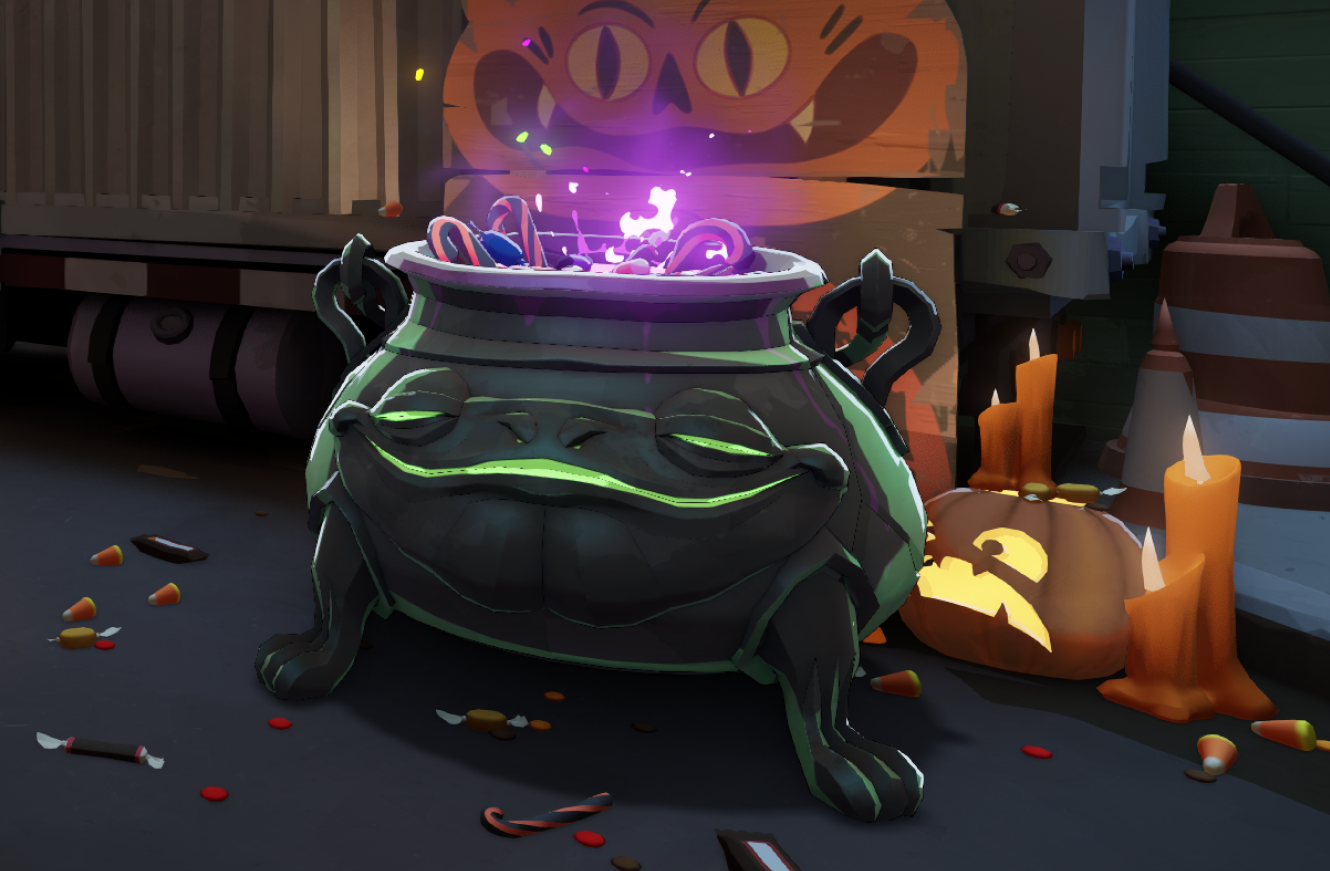
Sinner's Sacrifice grants Golden Statue buffs, and the way you last-hit it matters more than most players realize. Kill it with a Heavy Melee inside the timing window — there are visual and audio cues for it — and you get three Golden Statue buffs. Finish it with a Light Melee and you get one: same objective, triple the reward, decided by which button you press.
The Soul Urn is a carry-and-deliver objective, and its drop-off point moved in May 2026 from above the bridge in the mid lane to under the bridge in a side lane, a small change that rerouted every urn run on the map.
Bridges also spawn powerup buffs, each with its own ambient looping sound, so the map tells you when one is up before you can see it.
Getting Around: Ziplines, Vents and Bounce Pads
Movement is the skill that separates Deadlock players, and the map is built to support it.
Ziplines run above the lanes and are the standard way to travel between your base and the front. They are also a known vulnerability, and Valve has had to patch heroes for shooting people riding them.
Air vents push you upward, opening rooftop routes and escapes.
Bounce pads (jump pads) launch you across gaps. Valve added a looping sound to them in the world so you can hear one nearby.
Juke spots are deliberate pockets of cover built for breaking line of sight. Valve lists them as a map feature, not an accident of the geometry.
Breakables (crates, boxes and scenery) litter the map and hide pickups.
Add wall jumping on top and the honest summary is that the shortest path between two points in the Cursed Apple is almost never the street.
Reading the Minimap
The minimap carries more than hero positions. It shows what kind of powerup has spawned, not merely that one exists, so you can decide whether a bridge trip is worth it without walking there. Troopers are visible through walls during the laning phase, which replaced an older HUD element entirely.
Pinging and drawing are both built in. Valve expanded pings over several patches: you can ping an ability as "almost ready" with matching voice lines, there is a dedicated "leaving the area" ping for most heroes, and pressing ping before the match starts makes your hero play a taunt. Map drawing works alongside it — and if someone abuses either, muting a player also silences their map drawing, pings and chat wheel messages.
One honest caveat, because the question comes up constantly: Valve's patch notes do not document a built-in option for resizing or repositioning the minimap. City Never Sleeps added accessibility options and a HUD pass, so check the settings menu in your build rather than trusting a guide written against an older patch — including this one.
How to Explore the Map on Your Own
You do not have to learn the Cursed Apple in live matches. The Map Rework Update added a feature called Explore Map, which Valve describes as letting you "run around an empty city to test movement and navigation". You will find it under the 'Play' menu.
It is the right place to practice wall jumps, learn where the vents and bounce pads come out, and work out which rooftop connects to which, with nobody shooting at you. Experimental heroes from Hero Labs can also be taken into Private Lobbies, Private Bot Games and Sandbox at any time, if you want to test a kit against the terrain.

FAQ
Is the Deadlock map symmetrical?
Broadly yes in structure — both teams get the same lanes, the same Guardians, Walkers and Shrines, and the same route to the enemy Patron. It is not a mirror image in appearance, though: the outer lanes are themed as different districts, Amber Park and Sapphire York among them, so the two halves of the city look and feel distinct while playing the same.
What is the Deadlock map called?
Valve refers to the city as the Cursed Apple, a supernatural take on New York. Individual areas have their own names — Broadway storefronts, Central Park, the Walker arenas — but the map as a whole has no separate title the way a Counter-Strike map does, because there is only one.
Will Deadlock get more maps?
Valve has not announced any, and there is no sign of a second map in the patch notes. Its stated priorities for upcoming updates are reworking the Midboss, Guardians and Walkers on the existing map, not building a new one.
How big is the Deadlock map?
Valve has never published dimensions. What is documented is the shape: three lanes, a mid-boss pit between them, neutral camps between the inner and outer lanes, and a vertical layer of rooftops, bridges and ziplines above all of it. Any specific figure in meters you find online is a community measurement, not an official one.
Why did Deadlock go from four lanes to three?
Valve did not publish a design rationale beyond calling it a redesign, but the knock-on changes tell the story: four lanes spread ten players too thin, and the trooper bounty had to be raised afterwards specifically "to match the previous 4 lane global economy". Fewer lanes meant more contact, and the economy was retuned so games did not slow down as a result. Pacing matters more in this genre than people expect, as anyone who has watched a Dota 2 match run long will recognize.
Can I play on the old Deadlock map?
No. The pre-2025 four-lane layout was replaced, not archived, and there is no legacy mode or console command that restores it. The custom maps you will find circulating are community mods for movement practice, not Valve's old build.

Write comment