
How Sticker Value Actually Works
The core thing to understand: an unapplied sticker's price is not the same as the value it adds once it's on a skin. Applying a sticker doesn't trigger some fixed markup formula either — a stickered weapon becomes its own unique listing, and buyers price the craft as a whole based on the stickers involved, the base skin, and how desirable that specific combination is to collectors. Not all stickers sit in the same tier: plain paper stickers are the most common and least valuable, Holo and Foil versions carry a reflective or holographic finish that makes them scarcer, and vintage tournament stickers — especially from Katowice 2014, one of the earliest CS:GO Majors and the source of some of the game's most collectible stickers — occupy a category of their own.
This premium is often described in the community as sticker percentage or sticker overpay. A craft valued at "10% sticker price," for example, doesn't mean the whole weapon is worth 10% of the sticker — it means the buyer is assigning roughly 10% of the unapplied sticker's market value as extra value on top of the base skin. There's no universal percentage that applies across the board: rare or especially desirable crafts can be valued very differently from one buyer to the next.
Real Examples — From Six Figures to Almost Nothing
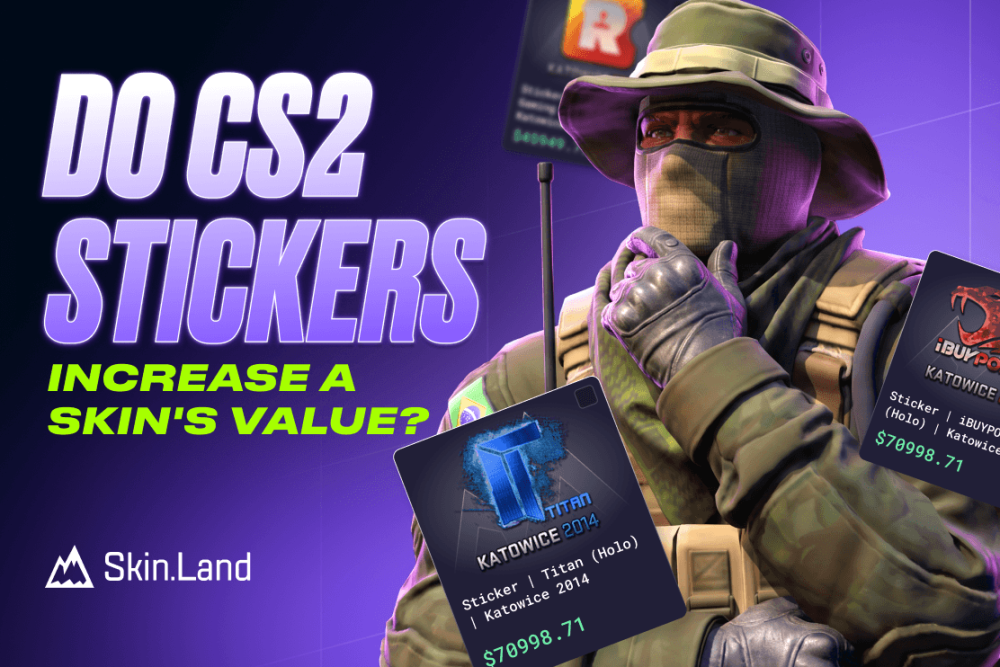
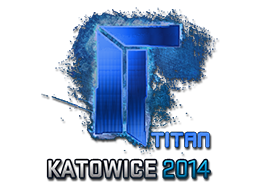
The gap between a valuable sticker and a worthless one is enormous, but even the valuable end doesn't transfer 1:1. A Titan (Holo) | Katowice 2014 can be worth tens of thousands of dollars as an unapplied sticker — currently around $74,000 in our catalog. Once applied, however, its full standalone value doesn't simply move over to the weapon. Collectors typically price the craft at a fraction of the sticker's unapplied value, and where exactly that fraction lands depends on the base skin, the sticker's position, the overall combination on the weapon, and how much collector demand exists for that specific craft.
A Crown (Foil) sticker sits much lower at around $340 — still genuinely valuable, though the same principle applies. Put one on a cheap base skin like AK-47 | Redline, which itself often lists for around $30, and the craft can meaningfully outprice the bare skin, but the actual premium a buyer pays typically lands well below the sticker's own $340 unapplied value, not on top of it. Compare that to a typical paper sticker from a recent Major (2024–2026), many of which list for around $0.12 each — a handful of those on a skin adds close to nothing to its resale value.

What Actually Determines the Boost
A handful of factors decide whether a sticker meaningfully raises a skin's price:
Sticker rarity and finish — paper stickers sit at the bottom, Holo and Foil are scarcer, and Gold-finish variants (where they exist) tend to command the highest prices within a given tournament's set.
Age and supply — stickers from early, discontinued tournament capsules have a finite supply that generally shrinks as unapplied copies are used in crafts, while stickers from newer tournaments usually have much larger available supplies.
Team or player recognition — a sticker from a tournament's most iconic roster tends to hold more collector demand than one from a team nobody remembers.
Number and placement — matching multi-sticker crafts can command a larger premium than a single sticker or a mismatched combination. Placement also matters, especially for expensive collector stickers.
Condition — an unscraped sticker generally contributes more to a craft's value than the same sticker after scraping. Scraping is permanent and can't be undone, so it can significantly reduce the premium collectors are willing to pay — it should only be done to cheap, low-value stickers you don't mind wearing down for looks. Our guide to scraping and removing stickers covers exactly how that mechanic works and when it's worth it.

When Stickers Don't Help (or Actively Hurt)
Most stickers in circulation add negligible value — a few current-season paper stickers on an otherwise plain skin won't meaningfully change what a buyer's willing to pay. A badly scraped or visibly damaged sticker can actively hurt a listing too, since some buyers specifically want a clean, sticker-free copy and will pass on a craft that looks worn in a way they didn't choose. It's also worth remembering that a rare sticker doesn't rescue a genuinely unpopular skin or finish the way it can boost an already in-demand one — the base item still matters. Our guide to what to look at when buying CS2 skins covers the other factors worth weighing alongside stickers.
FAQ
Do all CS2 stickers increase a skin's value?
No. Most modern stickers, especially plain paper versions from recent tournaments, add little to nothing — often just a few cents. Only scarce, sought-after stickers (vintage Majors, Holo/Foil/Gold finishes) meaningfully raise a skin's price.
What's the most valuable CS2 sticker?
Vintage Katowice 2014 stickers, especially iconic Holo variants such as Titan (Holo) and iBUYPOWER (Holo), are among the most valuable in the game — a Titan (Holo) | Katowice 2014 alone currently trades for roughly $74,000 as an unapplied sticker, due to its age, extremely limited remaining supply, and exceptional collector demand.
Are Holo and Foil stickers worth more than paper stickers?
Generally yes. Holo and Foil finishes are scarcer within any given sticker set, and that scarcity usually translates into a real price premium over the plain paper version of the same design.
Can I remove a sticker without losing its value?
No. Scraping is the only way to take a sticker off a skin, and it's a permanent, one-way process that gradually destroys the sticker rather than returning it cleanly. See the scraping guide linked earlier in this article for the full mechanic.
Does the number of stickers on a skin matter?
Yes — a matching multi-sticker craft generally draws a bigger price premium than a single sticker, especially when the stickers are all from the same tournament or team. Placement matters too, particularly for expensive collector stickers.
Should I buy a skin with stickers or a clean one?
It depends on what you want. A stickered skin can be a good value if the asking premium over a clean copy is reasonable for that specific craft, taking into account the stickers, placement, condition, and collector demand — but if you want a plain look or plan to apply your own stickers later, a clean skin is the simpler buy. Our CS2 skins investment guide and trading vs. investing guide cover the broader value questions worth thinking through either way.

Write comment